By Zac Stackell
In the high-stakes world of New York City real estate, square footage is currency. It dictates price, financing, and ultimate exit value. Yet, it is astonishing how many sophisticated High-Net-Worth investors and even seasoned developers transact based on a superficial understanding of what they are actually buying.
Most market participants look at a building's offering plan and accept the stated square footage as gospel. They see the walls that are built and assume that is the entirety of the asset.
My background is in engineering. When I walk into a building, I don't just see walls. I see a three-dimensional zoning envelope—a "volume budget" granted by the city. My job isn't just to sell the space that is currently occupied; it is to identify the "ghost floor area" that is legally buildable but currently untapped.
This is where the real margin lives. It’s the difference between buying a retail asset at market rate and engineering a value-add play that creates instant equity.
Here are two of the most common "hidden value" scenarios my team audits for clients every week.
1. The Basement vs. Cellar Game (Unused FAR)
In NYC zoning parlance, words matter. The difference between a "cellar" and a "basement" can be millions of dollars.
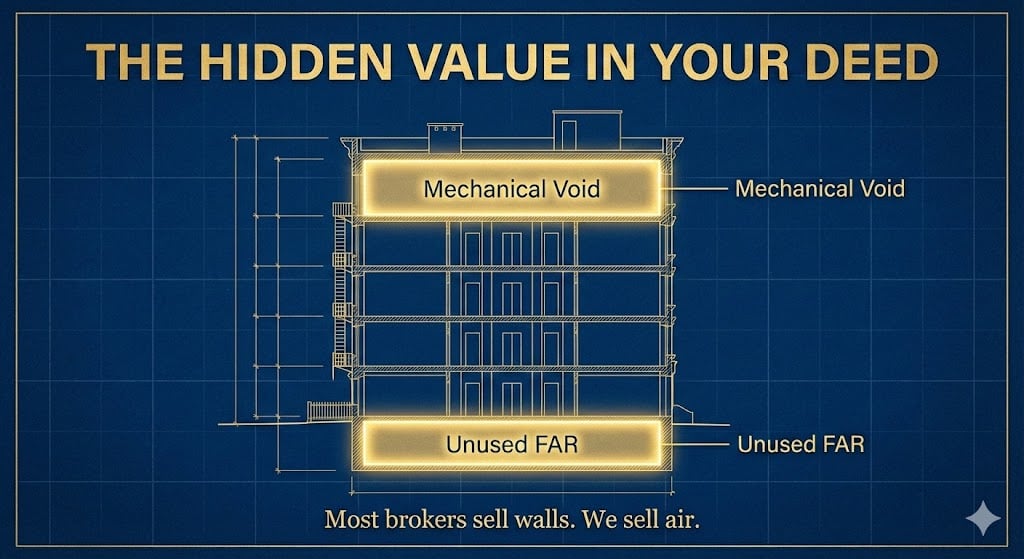
A cellar is a space where more than half of its height is below curb level. Crucially, cellar space does not count toward your allowable Floor Area Ratio (FAR). It’s "free" space, often used for storage or mechanicals.
A basement is a space where at least half of its height is above curb level. A basement does count toward FAR and can be legally occupied as premium living space.
Here is the opportunity: Many older buildings have levels that are currently designated as cellars but, due to the natural grade of the street or a sloping lot, could be re-classified as basements through strategic excavation or window enlargement.
Imagine owning a townhouse or a small multi-family building in Brooklyn. You have a dark, underutilized "cellar." By consulting with a zoning attorney and an architect, we can determine if lowering the floor a few inches or expanding window wells can legally transform that dank storage area into a high-income garden apartment or a massive recreation level for an owner’s triplex. You have just created hundreds of square feet of prime, legal residential space without building an addition.
2. The "Mechanical Void" Arbitrage
This is a strategy often associated with super-tall skyscrapers, but its principles apply to smaller developments as well.
NYC zoning allows for certain mechanical spaces—floors dedicated to HVAC, elevators, and water tanks—to be exempt from FAR calculations. Historically, developers have used oversized "mechanical voids" to push residential floors higher up, gaining better views and higher premiums without using up their precious square footage allowancce.
While the city has cracked down on egregious abuses of this loophole in recent years, there is still significant strategic value in how mechanical spaces are configured.
An older building may have inefficient, sprawling mechanical systems on a prime upper floor. By modernizing and consolidating that equipment into a smaller footprint, you can reclaim that "void" space. That square footage can then be re-allocated to enlarge a penthouse unit or create a stunning amenity space like a rooftop lounge.
You are essentially trading low-value mechanical space for high-value residential real estate.
The Verdict: Don't Buy Walls, Buy Potential
A listing sheet tells you what a building is. A zoning audit tells you what a building could be.
In the competitive 2026 market, you cannot afford to leave value unlocked. Whether you are looking to acquire a new asset or maximize the exit on a legacy holding, you need to understand the full potential of your zoning envelope.
Don't just buy walls. Buy the air.
Are you sitting on hidden square footage? Contact Zac Stackell for a confidential zoning and zoning audit of your property.