By Zac Stackell Douglas Elliman Real Estate
If you rely on the mainstream financial networks for your real estate insights, you likely believe that wealthy buyers have permanently relocated outside of New York City.
As a broker managing transactions for High Net Worth (HNW) clients, I can confirm that this narrative is a complete myth.
HNW end-users are not fleeing Manhattan; they are aggressively trying to upgrade their square footage within it. The friction in the market isn't a lack of buyers. It is a catastrophic failure of supply. We are currently experiencing what my team calls the "4-Bedroom Famine."
Here is why the inventory doesn't exist, and how the smartest capital in the city is actively manufacturing it for massive returns.
The "Missing Middle" of Luxury Development
To understand the current crisis, you have to look at what developers were incentivized to build over the last decade.
For the past ten years, the pro formas of NYC new developments were highly polarized. Developers maximized their Floor Area Ratio (FAR) by building one of two things:
-
High-density, 1- and 2-bedroom units designed to be sold quickly to investors or pied-à-terre buyers.
-
Ultra-luxury, full-floor penthouses priced at $30 million to $50 million.
In the rush to capture foreign capital and billionaire buyers, developers completely ignored the "Missing Middle"—the 3,000-square-foot, 3- to 4-bedroom home priced between $5 million and $8 million.
Today, the domestic HNW buyer is firmly planted in the city, demanding scale. When these buyers enter the market looking for a high-capacity primary residence in prime neighborhoods like Tribeca, the West Village, or the Upper West Side, they are met with a brick wall of zero inventory. When a high-quality, renovated 4-bedroom footprint finally hits the market, it immediately triggers a bidding war, entirely detached from the broader interest rate environment.
The Play: The Horizontal Arbitrage
Because the developers failed to supply the product, the secondary market is stepping in to manufacture it. The most lucrative transaction in NYC real estate today is the Horizontal Combination.
While 4-bedroom units are experiencing a massive scarcity premium, standard 1- and 2-bedroom units are facing headwinds. Slower buyer velocity in the middle market and high monthly carrying costs have left many of these smaller units languishing on the market.
This creates a textbook arbitrage opportunity.
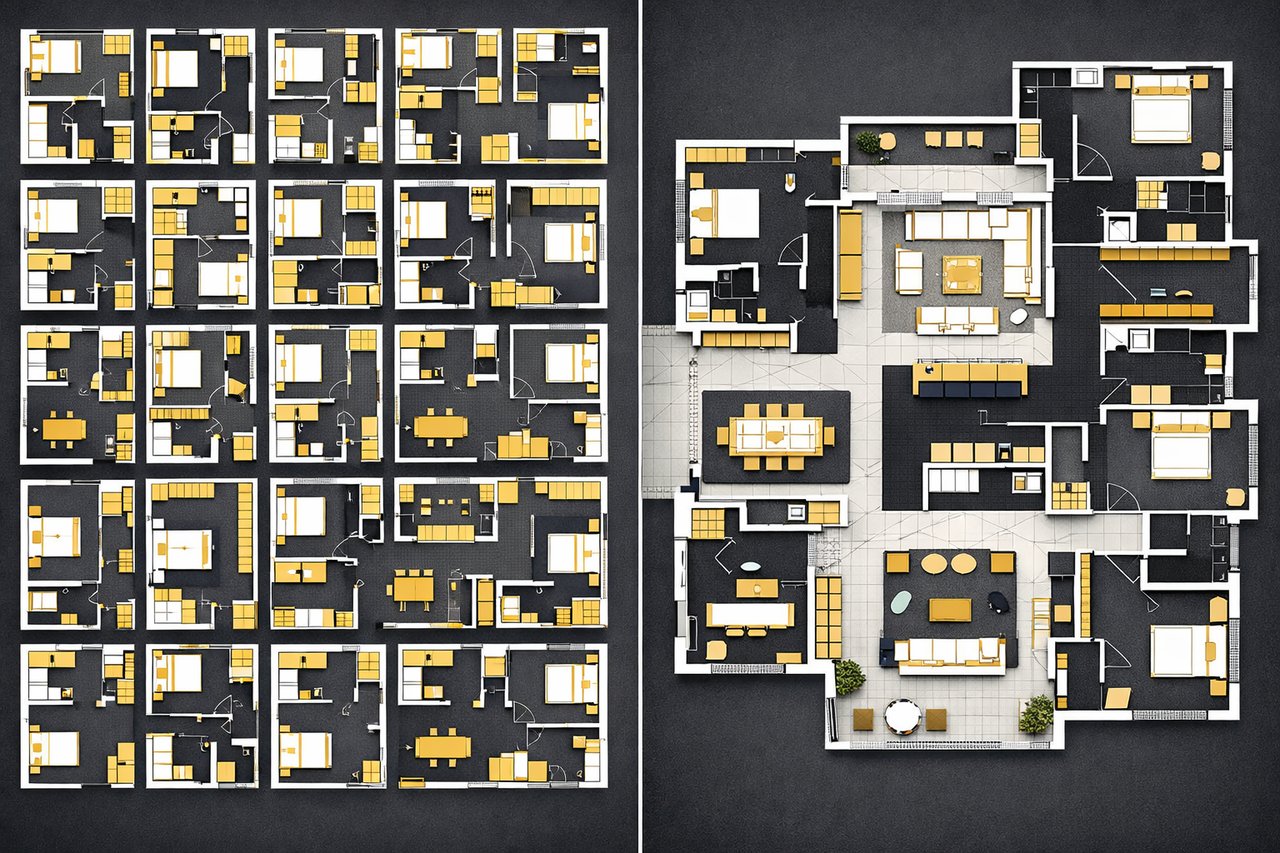
Our team is actively identifying adjacent units (e.g., Unit 14C and 14D) in premium buildings. The strategy is to acquire both smaller units at a discount from fatigued sellers.
The math is highly compelling. If you purchase two adjacent 1,500-square-foot units at $2,000 per foot ($3M each, $6M total basis) and combine them, the resulting 3,000-square-foot layout does not simply hold its $6M value. Because of the severe inventory famine for large-scale homes, that newly combined unit immediately commands a scarcity premium, often trading at $2,500+ per foot (a $7.5M+ valuation).
You are taking two commodity assets, running them through the Department of Buildings, and engineering a unicorn.
The Verdict
The media narrative of the "empty city" is fundamentally flawed. The capital hasn't left; it just can't find anything to buy.
For HNW buyers and investors willing to stomach the NYC Department of Buildings and a four-month renovation, the horizontal combination is the single greatest wealth-creation tool in the current residential market.
Don't wait for developers to fix the inventory crisis. Start looking at your neighbor's floor plan.