By Zac Stackell
In New York City real estate, we’ve reached a tipping point where the "bones" of a building are officially outshining the beauty of its lobby.
My grandfather was a NYC engineer. He taught me a lesson that has become the North Star of my career: a building’s true value isn't found in the marble or the doorman; it’s in the mechanicals. In 2026, that isn't just an engineering philosophy—it’s a financial reality.
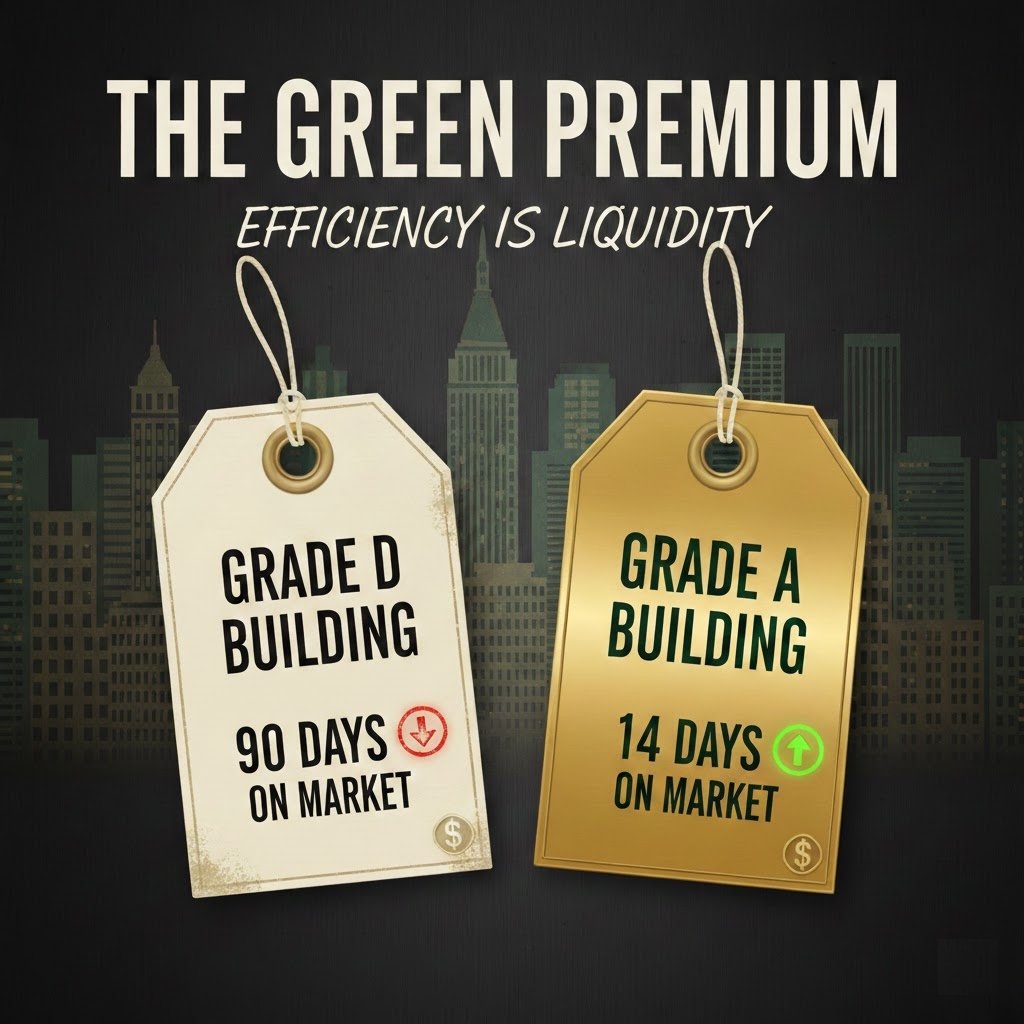
We are currently witnessing a massive divergence in the market that I call the Efficiency Gap. On one side, we have Grade A, high-efficiency assets that are trading at a premium and moving in an average of 14 days. On the other, we have buildings with lagging energy grades that are languishing for 90 days or more.
In a high-velocity market like ours, Efficiency is Liquidity.
The New Math of the Exit
For years, energy efficiency was tucked away in the "sustainability" section of the pitch deck—a nice-to-have, but rarely the deal-breaker. That era is over. Today, savvy investors and high-net-worth buyers view a building’s energy grade as a primary risk indicator.
When an asset is sitting on the market for three months, it isn't usually a location problem; it’s a performance problem. Capital is fleeing underperforming assets because the "math of the exit" has changed. Buyers are no longer willing to inherit the deferred maintenance and looming operational costs of an inefficient system. They want assets that are "plug-and-play" for a future where energy costs are a fixed, manageable variable rather than a volatile liability.
The "Mechanical" Premium
If you look at the properties moving the fastest in Manhattan right now, they share a common thread: elite mechanical systems. Whether it’s modernized HVAC, smart building integrations, or optimized envelopes, these features are the new "luxury" amenities.
As a broker, I’ve seen firsthand how a Grade A rating serves as a cap rate protector. It signals to the market that the property is future-proofed. It tells a buyer that they won't be hit with massive capital expenditures or operational fines three years into their hold period.
Don't Get Stuck in the Gap
The "Efficiency Gap" is only going to widen. As more high-quality, efficient inventory comes online, the "Grade D" buildings will face an increasingly steep discount—not just in price, but in time.
If you are a building owner, your mechanical room is no longer a cost center; it is your most powerful marketing tool. Investing in efficiency isn't just about "going green"—it’s about ensuring that when you’re ready to trade, the market is ready to meet you.
At Silverstein Stackell, we don’t just look at the comps; we look at the controls. We help our clients understand the technical fundamentals that drive market velocity. Because in NYC, the most expensive building is the one that won’t sell.
Would you like me to help you format this into a newsletter template for your clients, or should we create a secondary "technical" one-pager to give to prospective buyers?
Smart building technology for energy management This video provides data-driven insights into how building performance and tech integration are currently shaping leasing and market fundamentals in NYC for 2026.