By Zac Stackell
There is a unified, data-driven psychological shift driving the ultra-luxury markets in both Manhattan and the Hamptons. High Net Worth (HNW) buyers have stopped underwriting aesthetics and started underwriting survival.
Whether they are deploying capital into a $10 million city pied-à-terre or a $20 million summer compound, the mandate is exactly the same: Strip out the infrastructural risk.
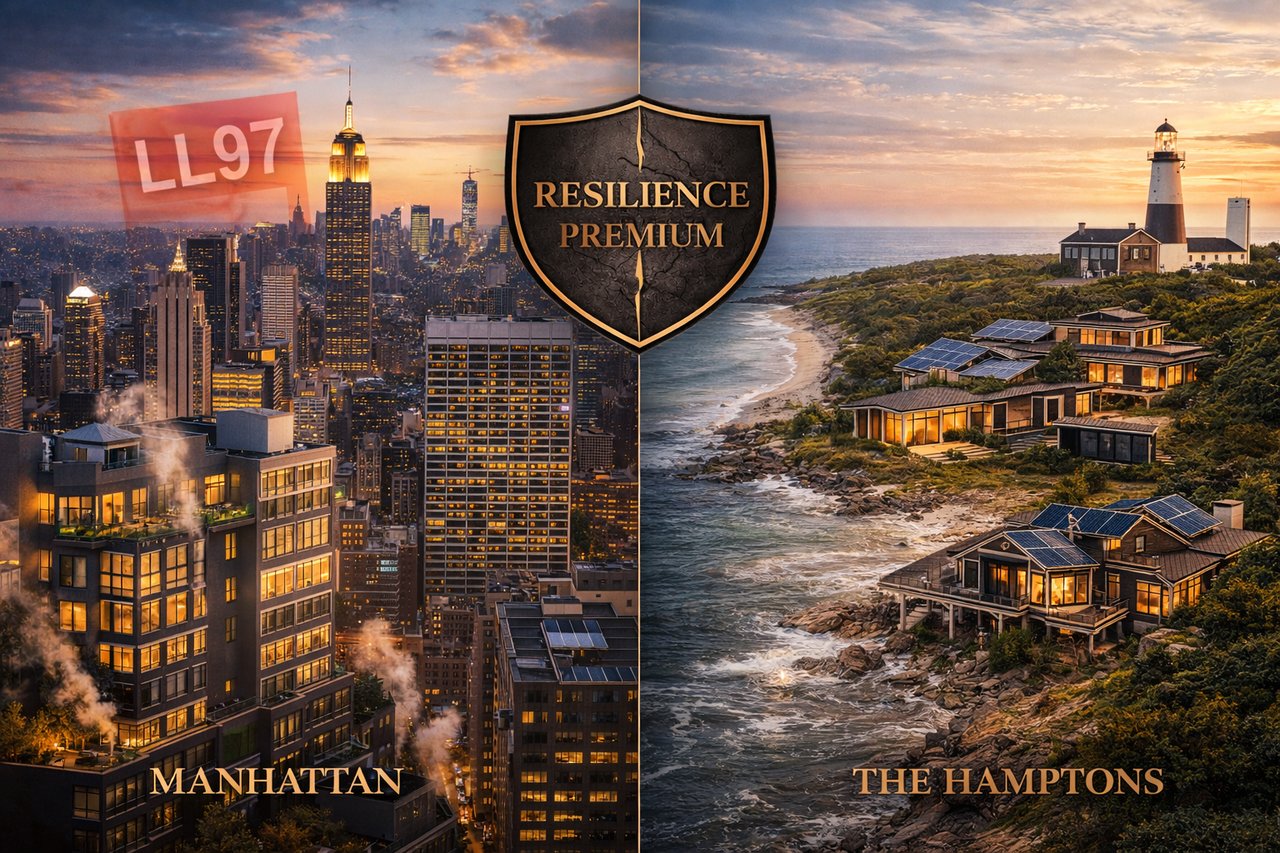
We call this "The Resilience Premium." Buyers are paying massive premiums to detach themselves from failing municipal grids, uninsurable coastlines, and punitive city regulations. Here is the hard ledger dictating how this capital is moving in 2026.
Manhattan: The LL97 Liability and the Passive Escape Hatch
In New York City, the catalyst is strictly regulatory.
For the last century, the pinnacle of NYC real estate was the pre-war co-op. Today, those buildings are facing an existential financial threat: Local Law 97 (LL97). The compliance period is active, and the penalty phase is actively destroying Net Operating Income (NOI) and resale values.
The math is brutal: Buildings that exceed their emissions limits are legally mandated to pay $268 per metric ton of CO2 equivalent over the cap. For a standard 100,000-square-foot pre-war co-op running on a legacy central steam boiler, that translates to over $100,000 in annual fines starting right now—and those limits tighten drastically in 2030.
To avoid these recurring fines, co-op boards are levying massive, multi-million dollar assessments on shareholders to electrify 100-year-old infrastructure. Because of this, the smart money is executing a flight to quality. They are abandoning legacy infrastructure for Passive House new developments. Through extreme insulation, airtight thermal envelopes, and energy-recovery ventilation, Passive House buildings consume up to 90% less heating and cooling energy than standard construction, rendering them functionally immune to LL97 fines. The institutional data proves this shift: energy-efficient assets are currently seeing a 13% to 36% value premium on transaction prices compared to non-compliant counterparts. Buyers are mathematically offsetting the premium they pay for the condo against the fines they avoid from the co-op.
The premium has shifted. Buyers are no longer paying for the history of the building; they are paying for the engineering of the facade.
The Hamptons: The Coastal Cliff and the Inland Microgrid
Two hours east, the exact same buyer is applying identical risk-mitigation logic.
Historically, the highest valuations in the Hamptons were tied directly to immediate Atlantic Ocean proximity. Today, the immediate oceanfront is increasingly viewed as a volatile financial liability. Aggressive coastal erosion and the exodus of insurance carriers from high-risk flood zones have completely changed the underwriting math.
Between 2021 and 2026, coastal property taxes and flood/hazard insurance premiums spiked by over 50%. For properties below the Base Flood Elevation (BFE), subsidized $1,200 annual premiums are resetting to unregulated market rates that easily exceed $10,000 to $20,000 annually.
Look at adjacent luxury coastal markets: on nearby Nantucket, waterfront homes that traded for $2.3 million just a few years ago are currently being dumped for $600,000 due to rapid beach erosion and condemnations. HNW buyers in the Hamptons are watching that capital destruction and refusing to catch the falling knife.
The new benchmark for Hamptons luxury is the Inland Microgrid. Velocity is shifting inland to elevated village markets like Sag Harbor and deep North Haven. Buyers are taking the $15M they would have spent on an eroding dune and deploying it into 4-acre elevated lots to build fully autonomous ecosystems engineered with commercial-scale solar arrays, heavy battery storage systems, and independent wells.
When a severe winter storm knocks out the fragile East End power grid for four days, these compounds do not blink.
The Verdict
The HNW buyer in 2026 is a realist. They understand that holding an asset reliant on a 1920s boiler or sitting on an eroding sand dune is bad business.
The "Resilience Premium" is the strongest force in the current market. If you are developing, selling, or holding luxury real estate, your asset will be judged on its engineering, its autonomy, and its regulatory immunity.
Stop buying liabilities wrapped in marble. Start buying infrastructure.