By Zac Stackell
In New York real estate, the most dangerous word in the English language isn't "Recession." It isn't "Vacancy."
It’s "Wait."
For the last 18 months, I’ve sat in boardrooms with some of the city’s sharpest High-Net-Worth families. We look at their portfolios—mixed-use buildings in Chelsea, legacy multi-family in the Heights, commercial lofts in Tribeca. And when I show them the maintenance costs, the Local Law 97 carbon penalties, and the stagnant rent rolls, they all say the same thing:
"We’re going to wait for rates to drop another 50 basis points."
It sounds prudent. It sounds safe. But as we enter Q1 2026, it is mathematically wrong.
While the majority of the market is "waiting" for a perfect interest rate environment that may never return, the Smart Money has already started moving. They aren't trying to time the bottom of the rate cycle; they are timing the return of liquidity.
The Divergence: What the Data is Screaming
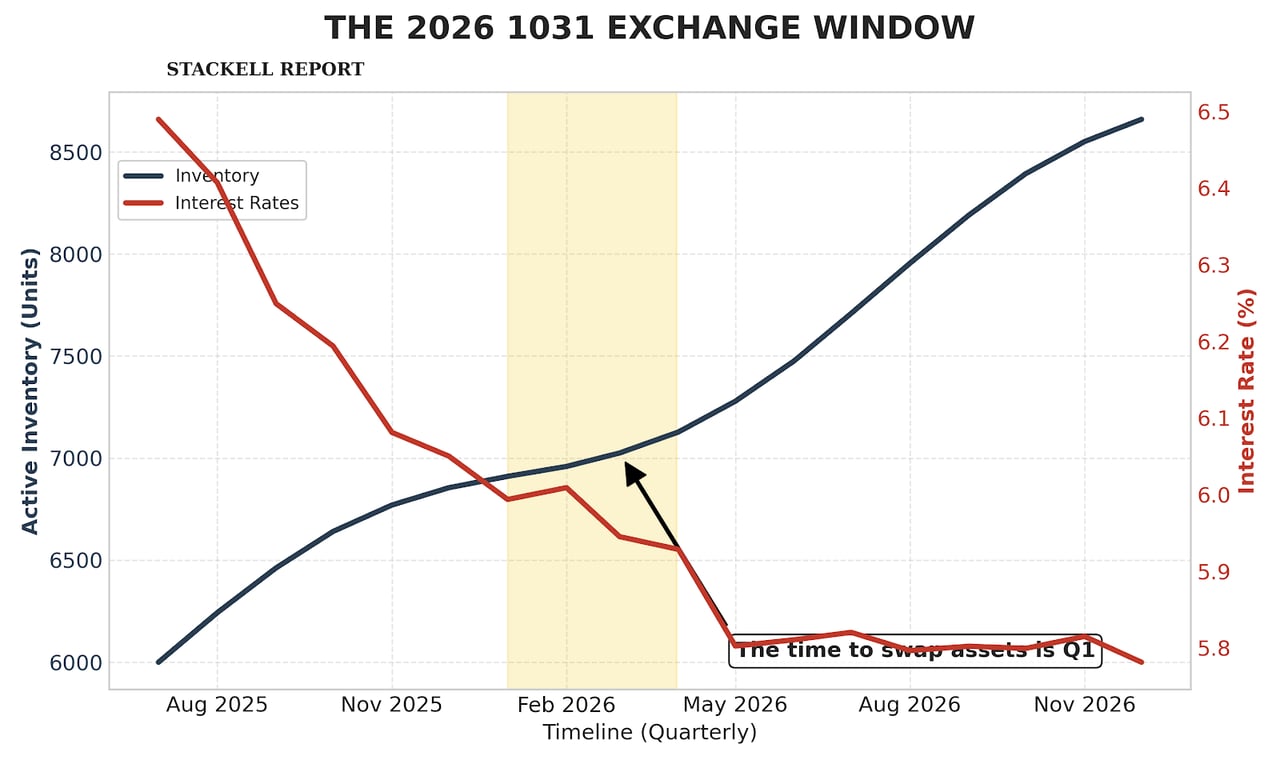
If you look at the Stackell Report (see the graph below), we are witnessing a market divergence we haven't seen since 2019.
-
Inventory is Peaking (Liquidity): For the first time in two years, we actually have quality inventory to buy. According to the recent Douglas Elliman Q4 2025 Market Report, listing inventory has stabilized while sales velocity is ticking up. This means you can finally find a replacement asset that isn't a compromise.
-
Rates are Stabilizing (Certainty): We aren't seeing the wild volatility of 2024. Lenders are lending again. As noted in the IPX1031 2026 Market Outlook, the stabilization of rates is driving a 20% increase in transaction volume.
This intersection—high liquidity meeting rate certainty—is what I call the 1031 Exchange Window.
The "Legacy" Trap
Many of you reading this are holding what I call "Legacy Assets."
These are buildings your family bought in the 1980s or 90s. They have tremendous embedded capital gains. But they also have tremendous headaches: aging boilers, non-compliant facades, and management-intensive tenants.
In 2026, these assets are risky. The IRS 1031 Exchange rules remain the single most powerful tool in the tax code to solve this. They allow you to swap a "high-headache, low-yield" building for a "low-headache, high-yield" asset—without triggering a taxable event.
But a 1031 Exchange requires one thing above all else: Inventory to buy.
If you wait until June to list your property, you will be selling into a flood of competition. More importantly, when you go to identify your replacement property (you only have 45 days), you will be competing with every other seller who "waited" for the spring market.
The "Hidden" Bonus: The City of Yes
There is another reason to move now. The city has just handed us a gift.
Under the new City of Yes for Housing Opportunity zoning changes, commercial buildings built before 1991 are now eligible for residential conversion.
This is a game-changer for valuation.
If you own a Class B or C office building that has been struggling with vacancy, you are no longer selling a "tired office building." You are selling a "Residential Conversion Development Site."
My team is currently auditing three different commercial portfolios where the "Conversion Value" is 30% higher than the current "Cap Rate Value." But you only capture that premium if you market the asset correctly to the developer pool—not just the passive investor pool.
The Verdict
The window is open.
If you are holding cash-flowing, pristine, A-grade real estate? Keep it. Enjoy the yield.
But if you are holding a building that keeps you up at night—a building facing a massive LL97 retrofit or a facade repair you don't want to oversee—the time to trade is Q1.
Don't wait for the perfect rate. By the time the rate is "perfect," the inventory will be gone, and the prices will be 10% higher.
Don't time the bottom. Time the liquidity.