By: Zachary Stackell
For decades, the standard playbook for Manhattan luxury real estate was simple: residential value peaked on quiet, tree-lined side streets, while major two-way crosstown corridors were treated as "traffic sewers." Living on 14th, 34th, or 42nd Street meant compromising on constant honking, toxic idling emissions, and chaotic gridlock. Today, a radical shift in urban transit policy is rewriting that playbook.
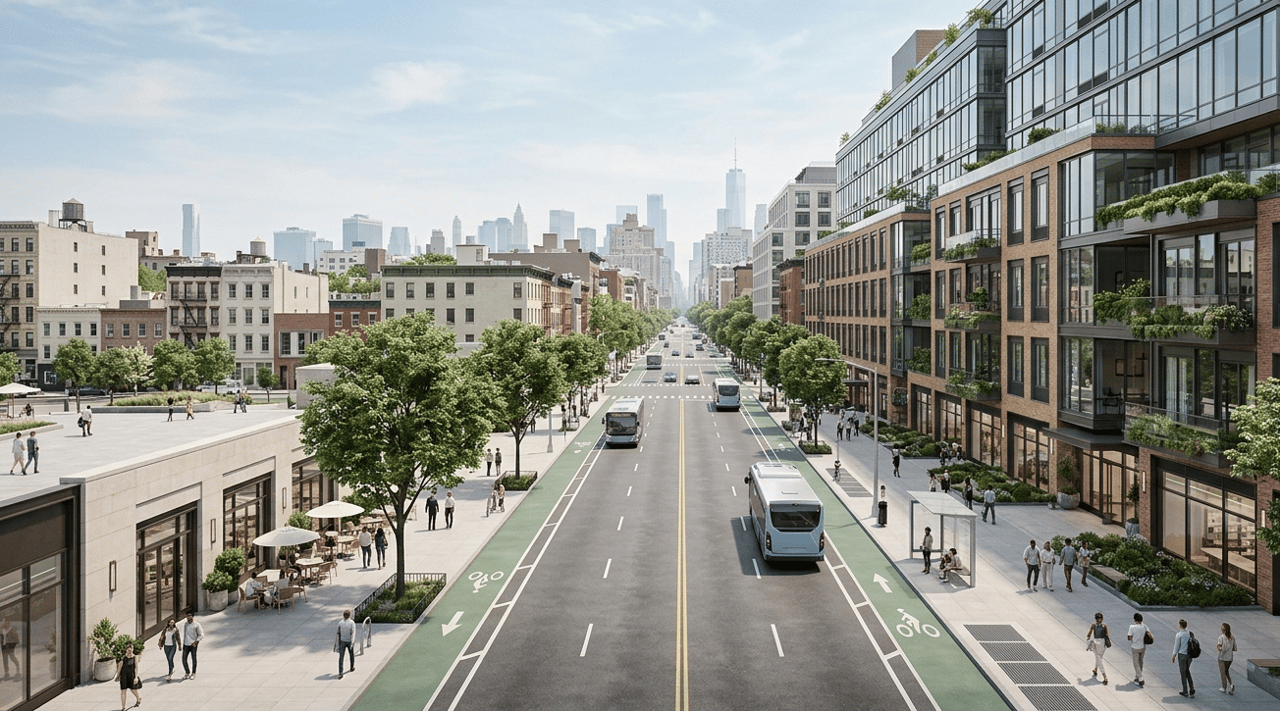
By prioritizing people over private vehicles, New York City’s 14th Street Busway has done something traditional zoning adjustments take years to achieve: it has fundamentally altered the auditory, environmental, and economic fabric of the street, transforming it into one of the city's most watched residential development corridors.
The Data Behind The Transformation
When the city restricted through-automobile traffic on 14th Street between 3rd and 9th Avenues, critics warned of economic stagnation and choked side streets. Instead, the data proved the exact opposite:
- Transit Velocity: Bus speeds plummeted in travel time, increasing overall velocity by up to 24%.
- Commuter Demand: Bus ridership spiked by 30%, creating an efficient pipeline of foot traffic.
- Safety & Peace: Traffic crashes on the corridor plunged by 53%, while pedestrian injuries dropped by 63%.
For real estate developers, this massive reduction in ambient noise and vehicle congestion turned a previously hostile avenue into prime real estate. When a street becomes predictably quiet, safe, and easily accessible, residential premiums naturally follow.
The New Luxury Lineup on West 14th Street
The most tangible proof of this "transit premium" is the wave of high-end residential projects currently transforming the corridor from a gritty commercial strip into an upscale residential anchor.
┌─────────────────────────────────────────────────────────────────────────────┐
│              UPMARKET RESIDENTIAL MOMENTUM ON THE 14TH STREET CORRIDOR       │
├──────────────────────────────┬────────────────────────┬─────────────────────┤
│ Property                     │ Design / Architecture  │ Inventory & Profile │
├──────────────────────────────┼────────────────────────┼─────────────────────┤
│ 101 West 14th Street         │ ODA Architecture       │ 44 Luxury Condos    │
├──────────────────────────────┼────────────────────────┼─────────────────────┤
│ 35 West 14th Street (Nexus)  │ Midblock/Modernist     │ 55 New Condos       │
└──────────────────────────────┴────────────────────────┴─────────────────────┘
Positioned at the vibrant intersection where Chelsea meets Greenwich Village, this striking, glass-faceted building designed by ODA Architecture features 44 luxury condominium homes. Bypassing the historic noise objections of a major cross-street, the project successfully commands top-tier pricing because the busway guarantees a calmer, more walkable urban streetscape right outside its double-height lobby.
Further solidifying this trend, Queens-based Nexus Development acquired a midblock parcel spanning 31-35 West 14th Street for $14.4 million. Shifting its focus toward this newly quieted corridor, Nexus has pushed forward on a 13-story, 55-unit residential luxury development featuring ground-floor retail. What used to be a row of low-rise storefronts is being elevated into high-density luxury housing, driven entirely by the corridor's long-term environmental shift.
The "Next Generation" Corridors: Scaling the Blueprint
The real estate market is already betting that the 14th Street model is not a one-off anomaly. As the city launches a $3 million capital redesign study to add permanent greenery, wider plazas, and advanced pedestrian infrastructure to 14th Street, smart capital is tracking other transit corridors primed for a valuation lift:
- Fulton Street & Livingston Street (Brooklyn): Much like Manhattan's pilot, intensive bus priority networks here have cleared out private vehicular bottlenecks. Savvy residential developers are snapping up air rights and midblock parcels along these corridors, banking on the fact that rapid, predictable mass transit outweighs car access for modern urban buyers.
- Canal Street & 34th Street Possibilities: While still heavily congested, urban planning coalitions are continuously advocating for expanded pedestrianization. For long-term investors, acquiring retail or residential assets on the fringes of these corridors represents a high-upside play if the city deploys the 14th Street framework citywide.
The Bottom Line for Investors
Transportation policy isn't just about moving people from point A to point B—it is fundamentally a tool for value creation. By replacing a slow, polluted traffic bottleneck with a rapid transit and pedestrian corridor, the city has de-risked the avenue for luxury buyers. The future of high-value Manhattan addresses won't be defined by how fast a car can move down the street, but by how well an individual can live on it.